Opinion · August 6, 2026 · 12 min read
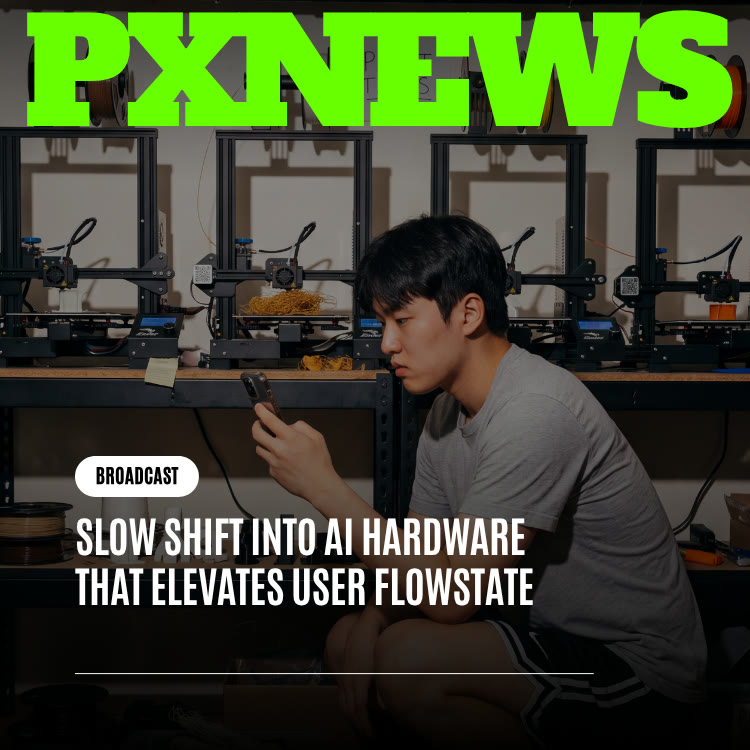
Slow Shift Into AI Hardware That Elevates User Flowstate
Why ETAPX is exploring AI hardware built to protect flowstate, what breaks deep focus today, and why the company is choosing patience over a hype-driven launch.
ETAPX is exploring AI hardware with one goal in mind: protecting flowstate, the deeply focused condition in which your tools fade into the background and the work simply moves. The company has not announced a device, a form factor, specifications, or a timeline, and that is deliberate. A product meant to guard your attention cannot credibly come out of a rushed, hype-chasing process, so ETAPX is settling the philosophy first and letting the schedule follow.
This is an opinion piece, not a product preview. It lays out how ETAPX thinks about focus, why the devices most of us carry make sustained concentration so hard, how the principle behind Influxx extends naturally into hardware, and what you can do to protect your own flowstate right now with the tools you already have.
Flowstate in Plain Terms
Psychologists have studied this condition for decades, and ETAPX does not claim to have discovered it. You have probably felt it: a stretch of work so absorbing that you stop noticing time, self-consciousness drops away, and effort starts to feel almost effortless. We spell it as a single word because in real life it does not feel like two concepts. You are either in it or you are not.
What every version of flowstate shares is that the instrument disappears. A writer stops thinking about the keyboard. A musician stops thinking about fingering. A developer stops seeing syntax and starts seeing the problem. The moment you become aware of the tool again, usually because it interrupts you, the state starts to dissolve.
How to Recognize It
Flowstate is easier to protect once you can spot it. Common signs include looking up and realizing far more time has passed than you thought, feeling challenged but not overwhelmed, knowing exactly what the next step is without stopping to plan it, and noticing that the usual itch to check something has gone quiet. It usually takes a while to arrive and only a moment to lose, which is why interruptions matter so much. The tasks most likely to produce it are ones with a clear goal, immediate feedback, and a level of difficulty that stretches your skills without exceeding them.
The goal is not a faster tool or a smarter tool. It is a tool quiet enough that you forget it is there.
What Actually Breaks Focus in a Normal Day
It is tempting to blame one big distraction. In practice, focus is rarely destroyed in a single blow. It is worn down by many small, individually reasonable interruptions that pile up across a day.
The Hidden Cost of a Single Ping
A notification does not need to be important to be expensive. Even if you dismiss it in a second, your mind has to find its place again in whatever you were doing. That rebuilding of context is the real cost, and you pay it every time. Spread across a typical day of alerts, badges, and banners, a few long stretches of concentration become dozens of short ones, each starting from a slightly colder place.
The Gateway Problem
The second cost is subtler. To do almost anything small, check a fact, confirm a time, send a quick reply, you pick up the same device that holds everything else in your digital life. You unlock it, navigate to the right place, finish the small task, and then, because the screen is already lit and full of options, you drift into two or three things you never planned to do. The issue is not any single app. It is that a single general-purpose screen funnels every task, important or trivial, through the same doorway.
Why a General-Purpose Screen Struggles to Guard Your Attention
A smartphone is a remarkable invention precisely because it can do almost anything. That same breadth makes it a poor guardian of a single moment of focus. When one device offers every app, every feed, and every message at once, the act of using it for one thing always carries the pull of everything else.
This is not a criticism of phones. It is a recognition that different jobs may need different shapes. A tool whose only purpose is protecting attention might need to be one that intentionally does less, by design rather than by limitation. That is the question ETAPX is sitting with: is there room for an object built solely to keep you in the work, rather than handing you an exit every few minutes?
From Influxx to Hardware: One Principle, Two Layers
ETAPX's thinking here grows directly out of Influxx. The idea behind Influxx is "outcome over conversation": the value of AI is not the chat itself but the finished result. A good tool should carry a task through to done rather than handing back an answer and stopping there.
Apply that same principle to attention and the question shifts. How might a tool carry your focus all the way through to the end of a thought, instead of breaking it with an alert and calling that engagement? With software, the gap Influxx addresses sits between a helpful response and a completed outcome. With hardware, the gap sits between a moment worth your complete concentration and a display that can only offer it bundled with every other app you own.
Influxx also has a habit worth noting here: it pauses to involve you only at genuine decision points and keeps working quietly the rest of the time. That is a small version of the attitude ETAPX wants any future hardware to carry. If you are new to Influxx, our article on agentic engineering for people new to AI is a helpful primer.
Designing by Subtraction: The Principles ETAPX Keeps Returning To
Most consumer technology of the past two decades has been tuned, intentionally or not, to bring you back as often as possible. That makes sense for a business that runs on attention. It is exactly backwards for a product whose purpose is protecting focus. The two goals diverge from the very first design decision, not just at the edges.
So the early conversations at ETAPX focus less on capabilities and more on refusals. A few principles keep coming up:
- Available, never insistent: ready when you reach for it, silent when you do not.
- Confirmation without a glance: letting you know something worked without stealing the visual attention you are using elsewhere.
- Fewer steps to a small task: shrinking the gap between an intention and its completion.
- Interruptions that must be justified: speaking up only for choices that truly require you, and keeping quiet about the rest.
- Silence as a valid response: recognizing that most of what happens in an hour does not need your attention right now.
You will notice nothing in that list about materials, sensors, shapes, or specs. Those are later decisions. Made too early, they harden around assumptions nobody can explain afterward. ETAPX prefers a patient, precise answer to why over a fast, fuzzy answer to what. For background on where this exploration began, see ETAPX's move toward AI hardware.
Why ETAPX Refuses to Rush AI Hardware
AI hardware is a crowded conversation across the industry right now, and that is exactly when discipline matters most. There is an obvious contradiction in building a device meant to protect focus through a frantic, deadline-driven sprint designed to catch a news cycle. A scattered process tends to leave its scatter in the finished product, no matter how good the intentions were. Calm is hard to design from inside chaos.
AJ, ETAPX's founder and CEO, has been clear on this point. If you want background on him, read our profile of AJ. In short, he has no interest in announcing something simply to be part of the hype. If ETAPX ever ships a device like this, he wants the reason behind it to be just as plain as the rest of the company's work: guard something people truly care about, and leave the rest of their day alone. You can hear more of his thinking in CEO AJ's conversation on AI, tech, and new releases.
This is not a new posture for ETAPX. Through every wave of AI excitement so far, the company has watched closely, moved where the reasoning held up, and declined to move just because others were.
What Slow Looks Like From the Inside
Patience is easy to mistake for inactivity. At ETAPX the work is very much underway; it simply is not organized around a launch clock.
- Long conversations about what focus really requires: these happen long before any discussion of shape or styling.
- Testing ideas against real days: the team's own, and those of people who feel the strain of constant interruption most sharply.
- Room to say "not yet": concluding at any point that the right answer is to wait is treated as a valid outcome, not a failure.
The same standard shaped everything ETAPX has released so far, including Whistlr, GLSRM, and Influxx. None of them launched because a category was hot. Each began with a concrete gap that grew obvious enough that solving it beat discussing it. Hardware faces at least that bar, arguably a higher one, because a device that fails at protecting attention does not just waste the company's time. It adds one more demand to someone's day.
Protecting Your Flowstate Today, Before Any New Device
You do not have to wait for new hardware to defend your focus. The principles above translate into habits you can practice now with the devices you already own.
- Audit your notifications. Go through your apps and keep alerts only for messages from people and time-sensitive events. Everything else can wait for when you choose to check.
- Batch small tasks. Instead of picking up your phone for each quick errand, collect them and handle them in one or two set windows.
- Create physical distance. During deep work, put your phone in another room or face down out of reach. Removing the gateway removes the temptation.
- Define the session before you start. Decide what "done" looks like for the next block of time so you know when you have actually finished.
- Single-task your tools. Close tabs and apps that are not part of the current job.
- Protect the start. The first minutes of a work block are when focus is most fragile. Avoid checking messages right before you begin.
- Schedule recovery. Flowstate is demanding. Short breaks away from screens help you get back in more easily.
What This Means for Creators and Businesses on Whistlr
Creative work depends on flowstate as much as any other kind, and creators are often the people most surrounded by pings. A few habits on Whistlr help you build distraction-free time into your workflow.
- Batch your creation: record several Minis in one session using the Teleprompter and multi-clip tools, then save finished posts to drafts and publish later. Our guide to saving time creating covers more workflow ideas.
- Give ideas room to develop: block an hour with notifications off to brainstorm and script before you ever open the camera. Strong concepts come from focused thinking, and our tips on creating engaging content are easier to apply when you are not context-switching.
- Plan instead of reacting: the planning calendar in Business Suite lets you map campaigns, lives, product drops, and meetings, so each day starts with intent rather than a scramble.
- Let moderators carry the chat: during a live, appointing moderators and setting hidden words keeps you focused on the performance rather than policing comments.
- Control the comment flow: turn off comments or replies on specific whistles when you need a break from monitoring them.
- Post on purpose: use the most active times shown in your follower insights to choose when to publish, rather than checking stats every hour.
For businesses, the payoff of protected focus shows up in decisions as much as in content. Pricing, campaign budgets, and responses to customer disputes all benefit from a clear head rather than one split across a dozen open apps. Setting aside defined blocks for that kind of work, separate from the reactive rhythm of comments and messages, is one of the simplest productivity changes a small team can make.
The same idea underpins the hardware exploration: the best tools give you room to do your best work, then step aside.
Frequently Asked Questions
What is flowstate?
Flowstate is a condition of deep, uninterrupted focus in which you become absorbed in a task, lose track of time, and stop noticing the tools you are using. Psychologists have studied it for decades, and ETAPX treats it as the experience its future products should defend.
Has ETAPX announced an AI hardware product?
No. ETAPX is investigating hardware as a possible new direction, shaped by the ideas behind Influxx. It has not announced a device, form factor, specifications, or release timeline, and it is intentionally focusing on philosophy before product decisions.
Why is ETAPX taking its time with AI hardware?
A product meant to guard attention would be undermined by a frantic, trend-chasing build. ETAPX wants the reasoning behind any device to be clear first, and it treats deciding to wait as a valid outcome.
How does Influxx relate to AI hardware at ETAPX?
Influxx follows the principle of outcome over conversation: success means a finished task, not just a reply. ETAPX is applying that same principle to attention, asking how a device could carry focus through instead of interrupting it.
How can I protect my focus from phone notifications?
Limit notifications to people and time-sensitive events, batch small tasks into set windows, keep your phone out of reach during deep work, and define what done looks like before each session. Small changes like these can noticeably lengthen your stretches of focus.
How can creators stay focused while running a Whistlr account?
Batch-record content and save it to drafts, plan your week in the Business Suite calendar, use moderators and hidden words during lives, and check follower insights for the best posting times instead of monitoring stats constantly.
ETAPX did not invent the experience of forgetting your tools mid-task. What it wants to find out is whether hardware can protect that feeling on purpose. There is no device to show yet, and there is no rush to manufacture one, because a shift meant to give people their attention back deserves to be made at a pace that keeps it honest.