Company · August 6, 2026 · 12 min read
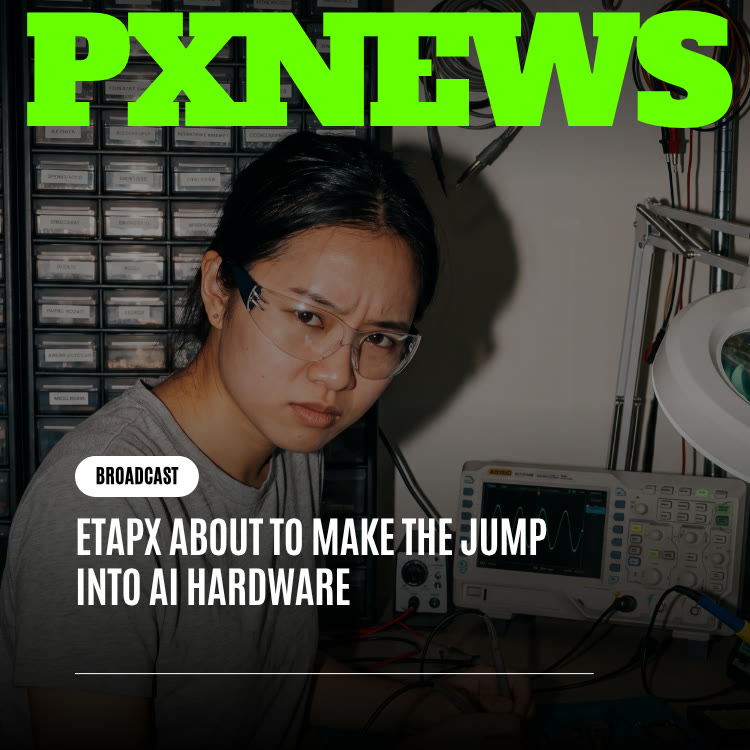
ETAPX About to Make the Jump Into AI Hardware
ETAPX is exploring AI hardware for the first time. Learn why, what the early research involves, and why there is no device, release date, or price yet.
ETAPX, the company behind Whistlr, GLSRM, Ocsidian, and Influxx, has begun exploring AI hardware, its first step toward making a physical product. There is no device, form factor, release date, or price yet. The work is early research and small internal experiments aimed at one problem: the effort it takes to get a useful idea out of your head and into software that can do something with it. Here is what the announcement includes, what it does not, and why it matters.
What ETAPX Actually Announced About AI Hardware
Hardware announcements usually come with a familiar package: a keynote stage, a glossy demo unit, an order page, and a shipping estimate. This one has none of those, by design. The entire announcement is that ETAPX has started investigating physical AI products seriously, for the first time since the company was founded.
That is a narrower claim than the headline might suggest, and ETAPX has been deliberate about keeping it narrow. There is no prototype being teased and no design waiting behind a curtain. What exists is a question the company considers serious enough to study openly, along with a commitment to share progress honestly as it happens.
If you came here looking for specifications, the short answer is that none exist yet. The longer answer, which the rest of this article covers, is why a software company would go public at such an early stage and what it is actually working on.
A First Physical Step for a Software-Only Company
Every product ETAPX has shipped so far runs as software on devices made by someone else. Whistlr is a social network with Minis, Chattr, and Flow. GLSRM gathers the AI landscape in one place. Ocsidian turns a written idea into a game you can play. Influxx takes a described goal and carries the work to completion. None of them has ever needed ETAPX to design an object you can hold.
That is what makes this moment notable. The company is not entering hardware because the category is fashionable or because other AI companies are circling it. It is looking at hardware because its own flagship work keeps running into a limit that software cannot remove on its own. Understanding that limit is the key to understanding the whole announcement.
The Problem Behind the Move: Thoughts Lost on the Way to a Screen
Ideas worth acting on rarely arrive at convenient times. They show up while you are cooking, walking, carrying groceries, or halfway through a conversation. Acting on one means stopping, finding your phone, unlocking it, launching an app, then retyping an idea that felt fully formed moments before.
Some of that effort is unavoidable. But much of it is overhead that every app charges simply for being reachable. Influxx pays that toll just like any other app on your phone, however capable it is once you reach it.
Why Small Delays Add Up
No single instance of this friction feels costly. It is a few seconds and a minor interruption. Multiply it across a day, a week, or a year, though, and a pattern appears: many good ideas never survive the trip to the keyboard. They fade before anyone writes them down, and the work they might have started never begins. Most people have experienced this, whether it is a task forgotten before reaching a desk or a message never sent because the moment passed.
Better apps make the work smoother once you arrive. Getting there faster may take a different kind of object.
Why the Phone Is Not Always the Answer
Smartphones are remarkable, but they are general-purpose by design. Every task competes for the same screen, behind the same lock, inside the same grid of apps and notifications. That generality is a strength for most things and a weakness for quick capture. The moment you unlock your phone to note a single idea, you are also exposed to every message, badge, and alert waiting for you, and the original thought can easily get lost in the noise. The question ETAPX is asking is whether there is a better path for that specific moment, not whether phones should be replaced.
How Influxx's Outcome-First Philosophy Points Toward Hardware
Influxx was built on the premise that the purpose of AI is the finished outcome, not the conversation. You describe what you need, and the environment carries it through instead of stopping at a helpful answer. That premise has held up, and the product keeps improving as ETAPX invests in it.
AJ, ETAPX's founder and CEO, has explained the connection in plain terms. Influxx assumed that describing a task was already quick and easy. Examined closely, that assumption turned out to be the original idea left incomplete, this time applied to the physical world rather than to software. In his telling, hardware is not a new philosophy for ETAPX. It is the existing one extended to a stretch of the journey no screen can cover.
Philosophy First, Device Question Second
The order matters. ETAPX did not notice a hardware wave and look for a reason to join it. The outcome-first idea came years earlier, and the device question only emerged after years of software work exposed where that idea runs out of road. That is the difference between borrowing relevance from a trend and following your own idea to its next logical question. For more of AJ's perspective on AI and upcoming releases, read CEO AJ Talks More About AI, Tech, and New Product Releases.
What the Exploration Phase Looks Like Day to Day
"Exploring hardware" can mean almost anything, so ETAPX has described what it means in practice. The reality is much less cinematic than a secret lab.
- Studying what exists: Learning how current device categories operate, what they get right, and how they disappoint their owners, all before assuming ETAPX could do better.
- Running small experiments: Rough, limited tests built to probe one narrow question instead of defining a product. Many are meant to be discarded.
- Leaving the shape open: No form factor has been chosen, and the team considers that appropriate for this stage rather than a gap to cover up.
- Avoiding a fake timeline: There is no release date because there is nothing yet to schedule.
- Sharing what is ready to share: Updates will come in honest pieces rather than a single dramatic reveal after years of silence.
Why Learning in Public
Hardware is often developed in secrecy, with leaks controlled tightly and a single staged launch at the end. ETAPX does not claim that approach is wrong. It simply prefers the rhythm it has used for its software, where products were discussed openly long before they were complete, and honest updates included things that did not work.
What a Good Answer Would Need to Do
Even without a design, it is possible to describe what success would look like. Any device that came out of this work would need to capture an idea faster than pulling out a phone, without demanding new habits that create friction of their own. It would need to respect privacy, since anything that listens for or receives your thoughts sits very close to your personal life. And it would need to hand work off to software like Influxx reliably, so the time saved at the start is not lost to errors later. These are criteria, not features, and ETAPX has not said how or whether a device will meet them. They are simply the bar any honest answer would have to clear.
Why Hardware Demands a Different Pace Than Software
Software tolerates a certain impatience. A rough release can go out, reveal its bugs, and be patched by tomorrow. Physical products do not work that way. Decisions become expensive to reverse much earlier, and the gap between attempting something and confirming it worked grows from hours into months.
ETAPX's CTO has been candid inside the company about this adjustment. His instincts formed in software, where mistakes are inexpensive and fast to undo. In hardware, a wrong decision can cost months, and you may not find out until much later. His stated approach is to deliberately slow those instincts down and spend this early period understanding constraints before making anything resembling a commitment. The appetite for building fast has not disappeared; it is being pointed at learning first.
The pace difference also shapes what the team can promise publicly. In software, a company can announce a feature and adjust it after launch based on feedback. In hardware, the physical design is largely locked once production begins, so the thinking has to be far more complete before anything is shown. That is another reason ETAPX is talking about questions now rather than answers.
That humility is useful. Teams that admit a transition is hard are more likely to handle it well than teams that pretend their existing skills transfer perfectly.
Questions ETAPX Has Not Answered Yet
Because "AI hardware" invites speculation, it helps to list what is not part of this announcement. As of now, ETAPX has not decided on:
- A form factor: What the device would look like, how it would be worn or carried, or whether it would be one device at all.
- Components: No chip, sensor, battery target, or materials have been chosen.
- Manufacturing: No production partner has been lined up.
- Timing: There is no release window or launch date.
- Pricing: No price has been set, because there is no product to price.
- Features: In principle, the idea is to shorten the path from a thought to action without the usual unlock-and-open detour. The real-world form of that idea remains undecided.
Any article or post offering specifics on these points is guessing. ETAPX has said it would rather tell people what it does not know than attach an invented spec sheet that falls apart at the first follow-up question. The company's view is that this candor costs a flashier headline but earns credibility for whatever comes next.
How to Read Early AI Hardware News
AI hardware is a crowded topic, and early announcements from many companies can be hard to interpret. A few habits will help you separate substance from speculation, whether the news comes from ETAPX or anyone else.
- Look for the problem statement: A credible early announcement explains what problem the company is trying to solve. ETAPX's is specific: the friction between a thought and action.
- Separate exploration from commitment: Research and experiments are not a product roadmap. Treat them as intent, not a promise.
- Be skeptical of leaked specs: If a company says no components have been chosen, rumored specifications are speculation.
- Watch for consistency: Does the hardware idea follow from what the company already builds? Continuity is a better signal than a sudden pivot.
- Follow the primary source: ETAPX has said updates on this exploration will appear first on its own news channels, described as plainly as this one.
What This Means for Whistlr Users, Creators, and Businesses
For anyone using Whistlr today, the practical answer is simple: nothing changes. Your account, your content, your storefront, and your campaigns work exactly as they did before. The hardware exploration is a separate, early effort, and it does not pull Whistlr's features in a new direction. The company has written separately about why it leans toward iOS and macOS for its releases, and that platform focus is unaffected by this news.
There is still something for creators and businesses to take from the way ETAPX has handled this announcement.
- Announce honestly: If you are working on a new product line or service, sharing early progress can build anticipation, but only if you are clear about what is real and what is not.
- Start with a problem: The strongest launches begin with a frustration your customers actually feel. Write it down before you decide what to build.
- Bring your audience along: Behind-the-scenes Stories, Q&A live streams, and polls in whistles let your peers follow your progress and shape it. See best practices for keeping that audience engaged.
- Do not invent urgency: Avoid fake deadlines or made-up specifications. Trust takes a long time to build and very little time to lose.
If you are curious about the company's direction more broadly, the best approach is the same one ETAPX is taking: stay interested, stay skeptical of rumors, and judge the work by what is actually shown when it is ready.
For more on how ETAPX thinks about this shift, read Slow Shift Into AI Hardware That Elevates User Flowstate.
Frequently Asked Questions
Has ETAPX revealed an AI device?
No. ETAPX has only said it is researching physical AI products. There is no device, prototype, or form factor to show, and no product has been confirmed.
When will ETAPX release AI hardware?
There is no release date. The company is in an early research and experimentation phase and has said it will not set a timeline before the thinking is done.
How much will an ETAPX AI device cost?
No price exists because no product has been defined. Components, manufacturing partners, and materials have not been chosen either.
Why is a software company exploring hardware?
Influxx is built to turn a described goal into a finished outcome, but people still have to stop and open a screen to describe that goal. ETAPX is exploring whether a physical device could make that handoff quicker and more natural.
Will the hardware exploration affect Whistlr?
No. Whistlr, its features, and its business tools continue as they are. The hardware work is a separate and early effort.
Where will ETAPX share AI hardware updates?
ETAPX has said updates will appear first on its own news channels, shared in honest increments as the exploration produces something real enough to discuss.
This is not a launch, and ETAPX has been careful not to dress it up as one. It is a software company admitting that one important problem may need more than an app to solve, and choosing to study it in the open. Follow PX Campus for future updates as the exploration develops.